Precipitation Diurnal Cycle in Climate Models
Overview: Global climate models often struggle with accurately simulating daily convection cycles, particularly over land, where precipitation peaks are frequently predicted too early. A new convective closure approach has been developed to address this issue by incorporating the role of shallow convection in balancing boundary layer changes throughout the day. This advancement has led to a marked improvement in the representation of diurnal patterns in both atmosphere-only and coupled ocean-atmosphere models.
The animation below shows CAPE tendency due to shallow convection (left) and CAPE tendency due to non-convective PBL processes (right). They tend to cancel each other out.
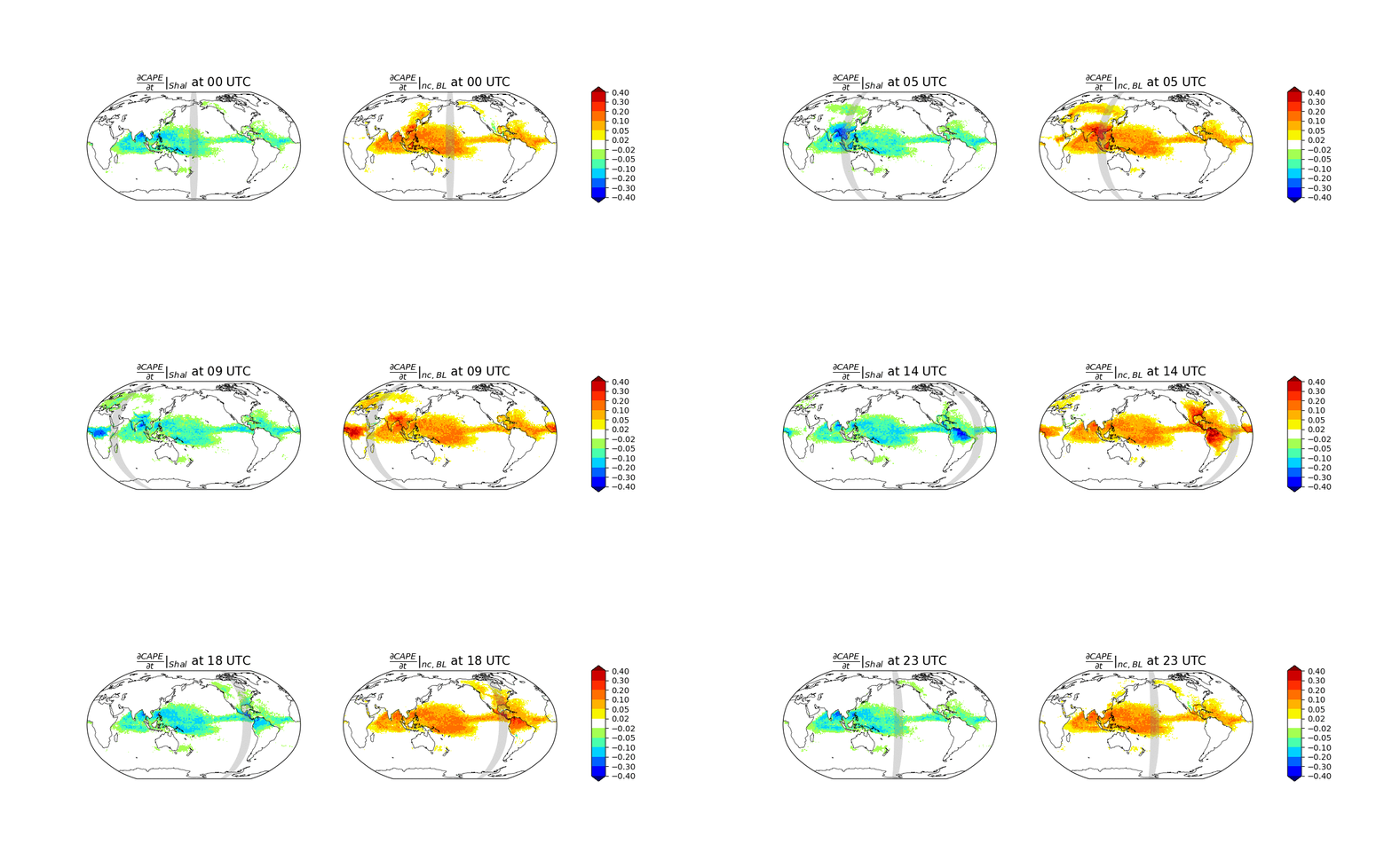
In climate models, quasi-equilibrium assumes that CAPE changes induced by non-convective processes (e.g., large-scale advection, surface fluxes, radiative cooling, and eddy diffusion) are approximately balanced by CAPE changes due to convective processes.
\[ \left( \frac{\partial \text{CAPE}}{\partial t} \right) = \left( \frac{\partial \text{CAPE}}{\partial t} \right)_{\text{nc,BL}} + \left( \frac{\partial \text{CAPE}}{\partial t} \right)_{\text{nc,FT}} + \left( \frac{\partial \text{CAPE}}{\partial t} \right)_{\text{deep}} + \left( \frac{\partial \text{CAPE}}{\partial t} \right)_{\text{shal}} \]
Previously, only deep convection was considered, which means:
\[ \left(\frac{\partial \text{CAPE}}{\partial t}\right)_{\text{deep}} = -\frac{\text{CAPE} - \text{CAPE}_0}{\tau} \]
Here, we need to consider the contribution from shallow convection, which leads to:
\[ \left(\frac{\partial \text{CAPE}}{\partial t}\right)_{\text{deep}} = -\frac{\text{CAPE} - \text{CAPE}_0}{\tau} {\color{red}- \left(\frac{\partial \text{CAPE}}{\partial t}\right)_{\text{shal}}} \]
Where \[ \text{CAPE}_0\] is a reference value toward which CAPE, having evolved by non-convective processes since its last adjustment due to convection, relaxes over an extended time τ.
Results: This adjustment delays peak land precipitation by approximately three hours and reduces diurnal phase biases by 50% compared to satellite observations. The figure below compares the original method (standard AM4), the new closure approach (relax QE D+S), and satellite observations (IMERG) for total precipitation, as well as a decomposition of convective and large-scale precipitation.
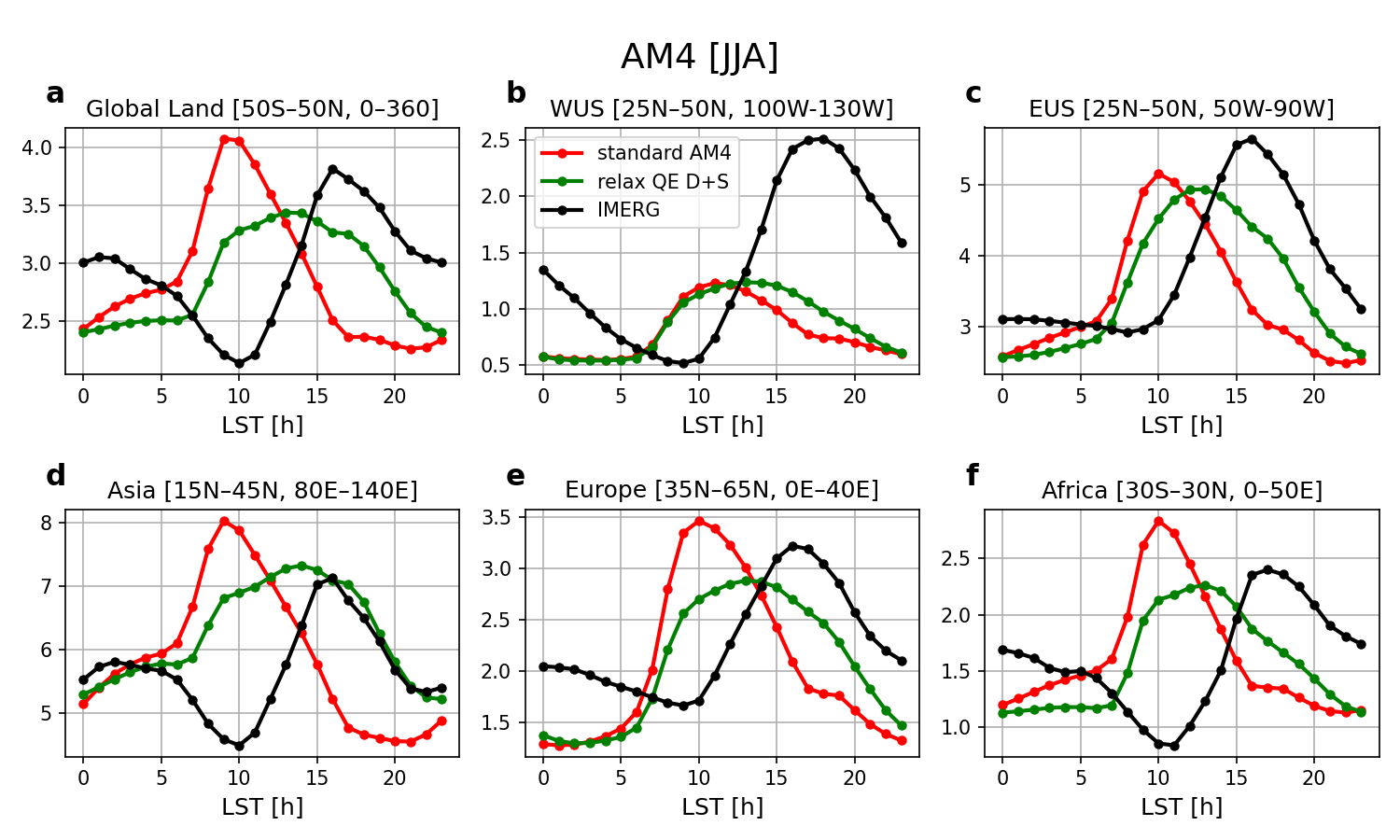
Diurnal cycle of precipitation.
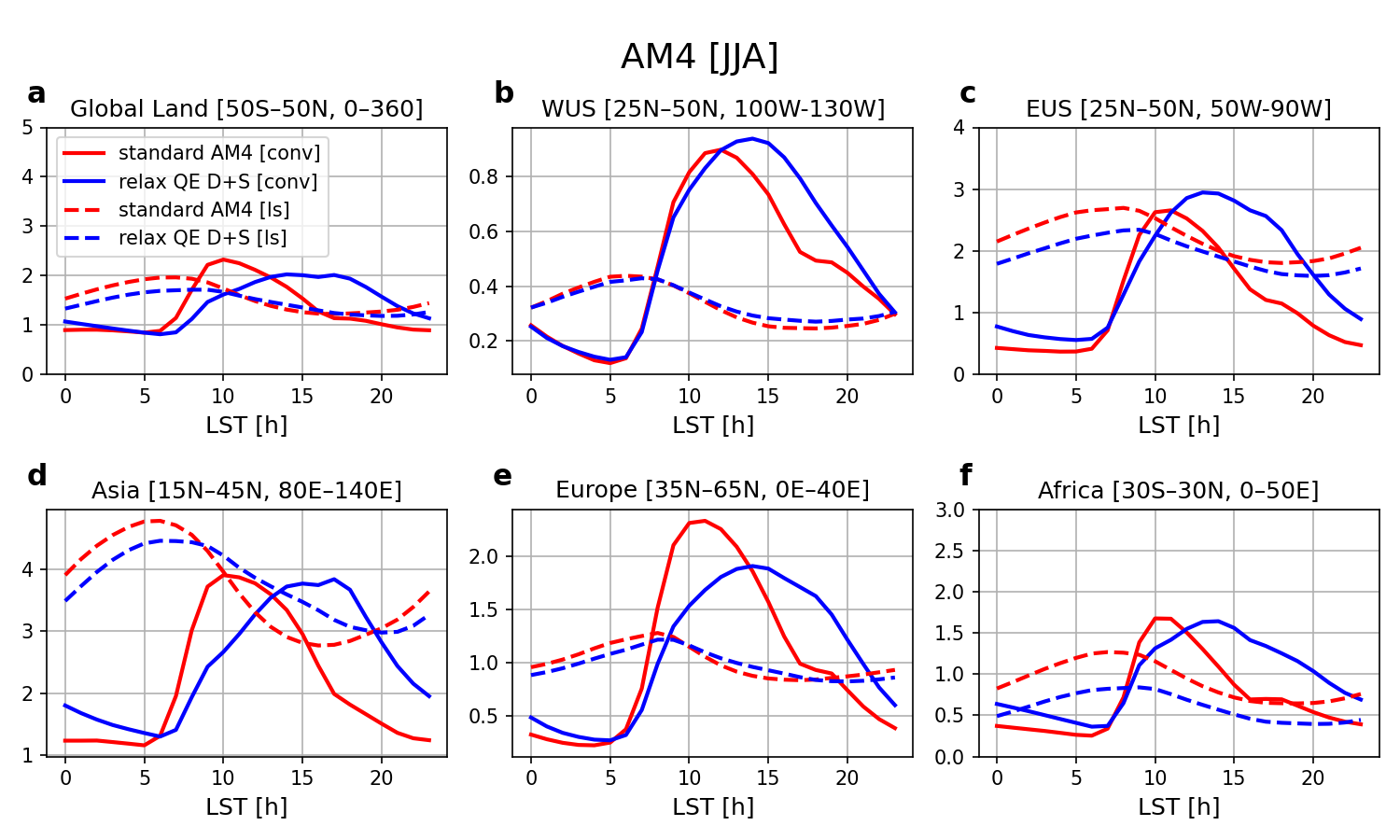
Phase bias reduction.