Historical Precipitation Trends
Overview: Future precipitation projections depend on evaluating how well models capture past changes. Using multiple atmospheric models and large ensembles, we separate externally forced signals from internal variability in precipitation trends since 1980. Forced trends are broadly consistent across models, while variability shapes most regional differences. Some ensemble members match observations, suggesting that certain regional wetting and drying patterns reflect external forcing. Zonal-mean land trends show a “wet gets wetter, dry gets drier” pattern in the Northern Hemisphere and drying near 45°S in the Southern Hemisphere tied to jet shifts.
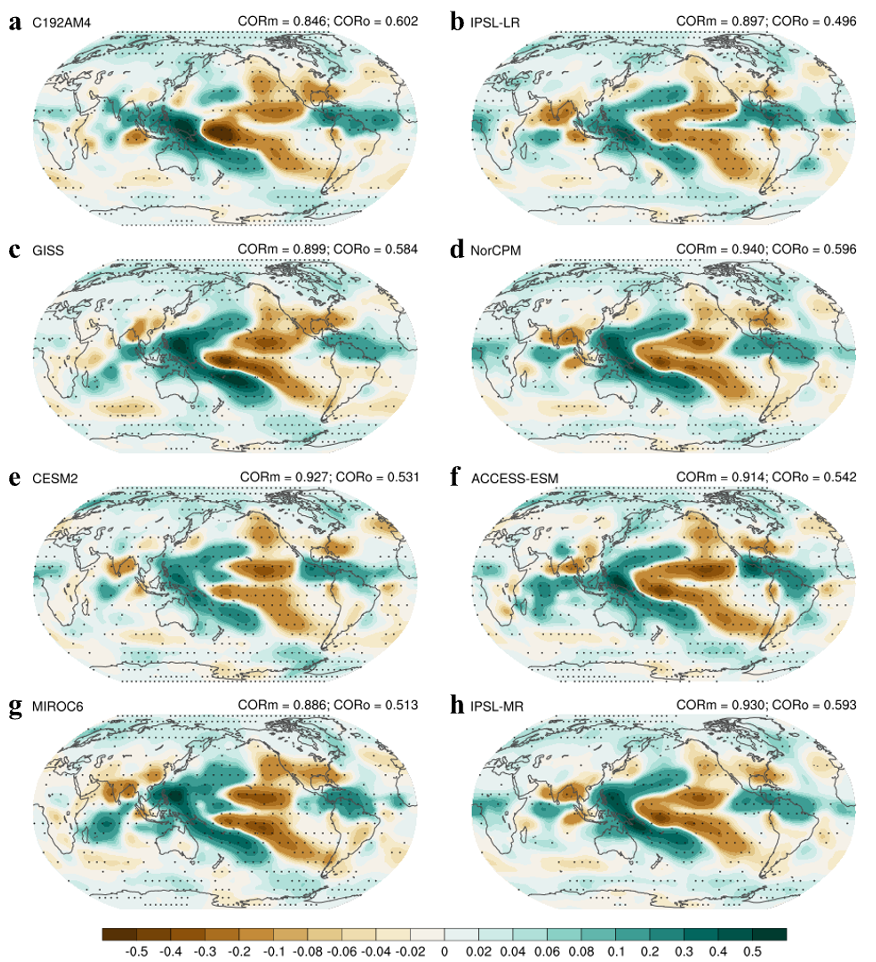
Ensemble-mean annual precipitation trends (mm/day/decade) from 1980 to 2014 for different AMIP6 models (Table S1 in Supporting Information). CORm denotes the pattern correlation coefficient between the ensemble mean of each AMIP6 model and the multi-model mean. CORo represents the global pattern correlation coefficient between the ensemble mean of each AMIP6 model and GPCP. Stippling indicates regions where at least 80% of ensemble members agree on the sign of the ensemble-mean trend.