Bosong Zhang

Journal of Climate (2023)

A Vertically Resolved Analysis of Radiative Feedbacks on Moist Static Energy Variance in Tropical Cyclones

Vertical MSE-variance diagnostics show that free-tropospheric radiative interactions are central to sustaining tropical cyclone development in realistic GCM experiments.

Vertical Structure VR-LMSE and VR-GMSE Intensity-Conditioned Diagnostics

Vertical Dependence

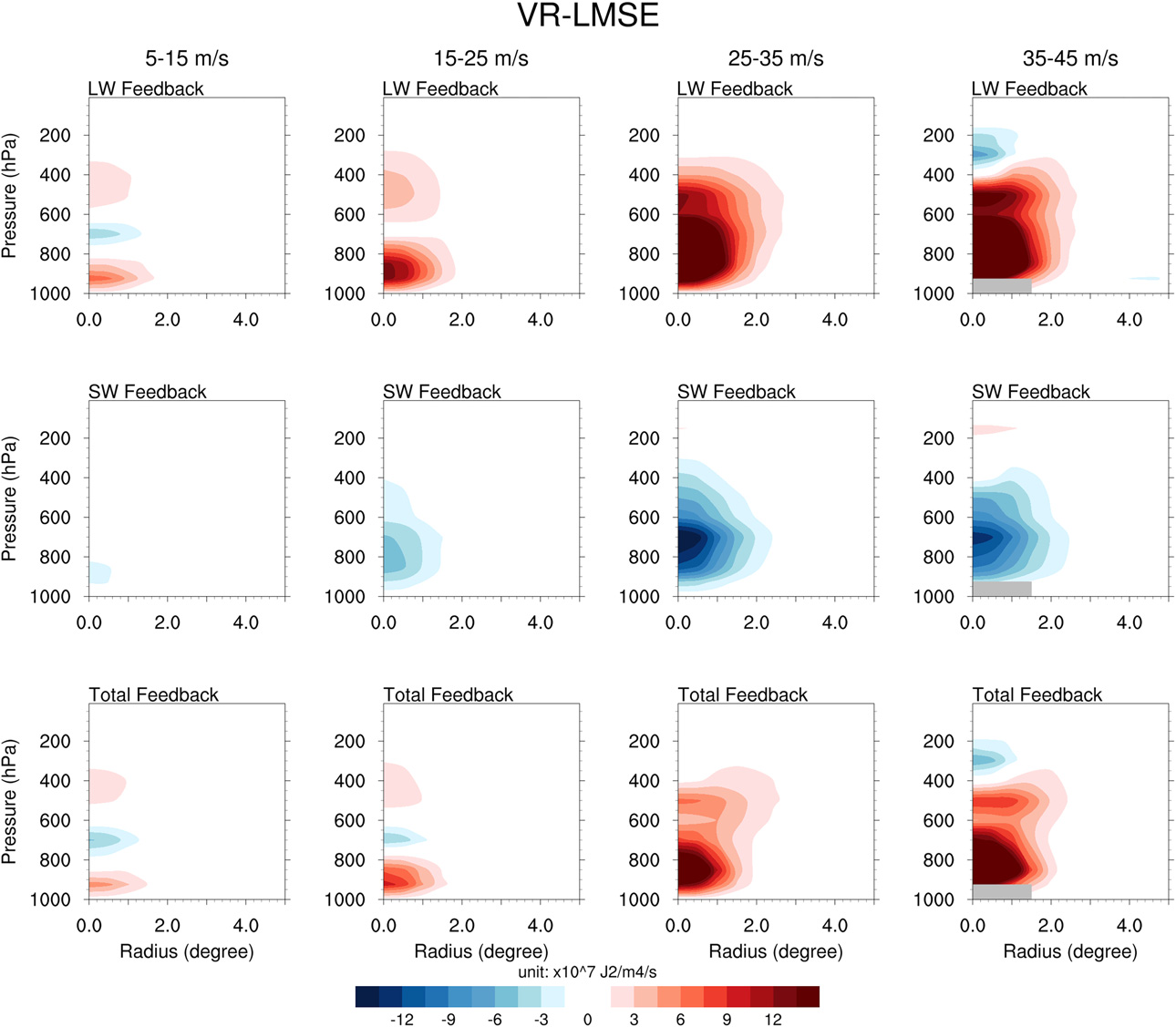
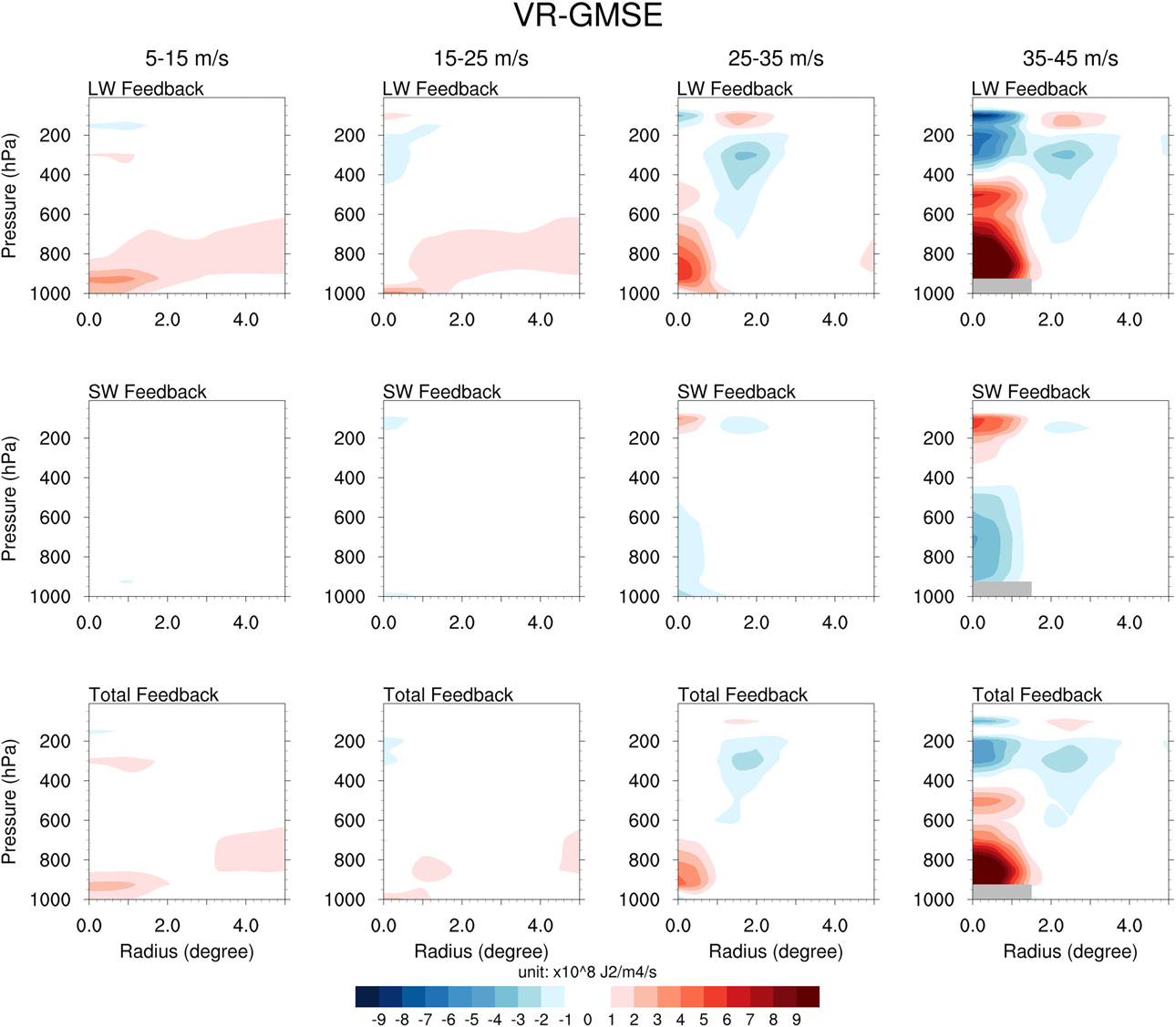
Feedback influence depends strongly on vertical placement within the storm column.

Intensity Structure

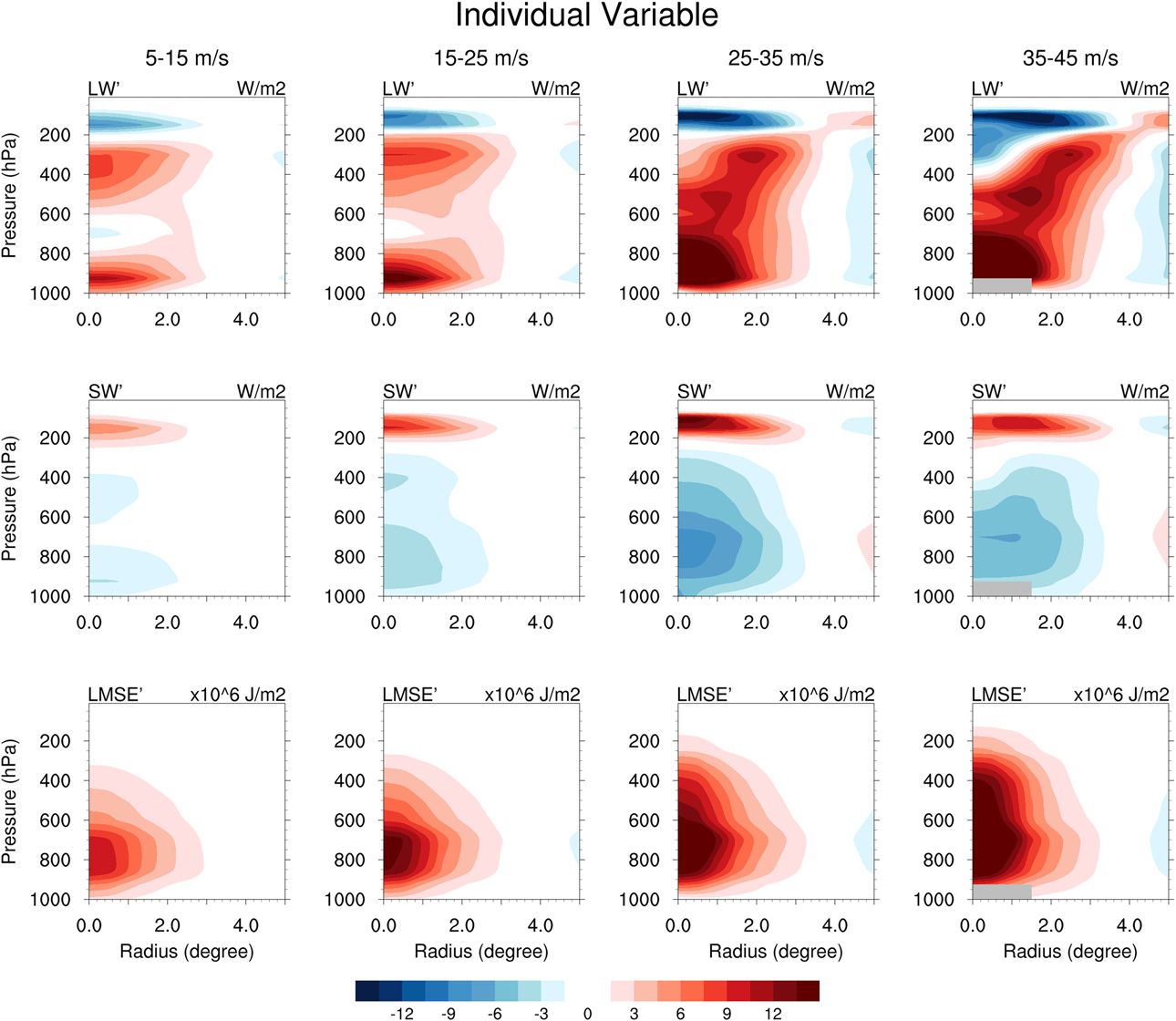
Radiative effects vary systematically from 5-15 m/s through 35-45 m/s regimes.

MSE Budget Closure

Coupled diagnostics separate LW/SW feedbacks and advection-convergence contributions.

Paper Citation

Zhang, B., B. J. Soden, and G. A. Vecchi, 2023: A Vertically Resolved Analysis of Radiative Feedbacks on Moist Static Energy Variance in Tropical Cyclones. Journal of Climate, 36, 1125-1141. https://doi.org/10.1175/JCLI-D-22-0199.1

Scientific Logic

  • Question: Which vertical layers of radiative interaction most strongly support tropical cyclone development?
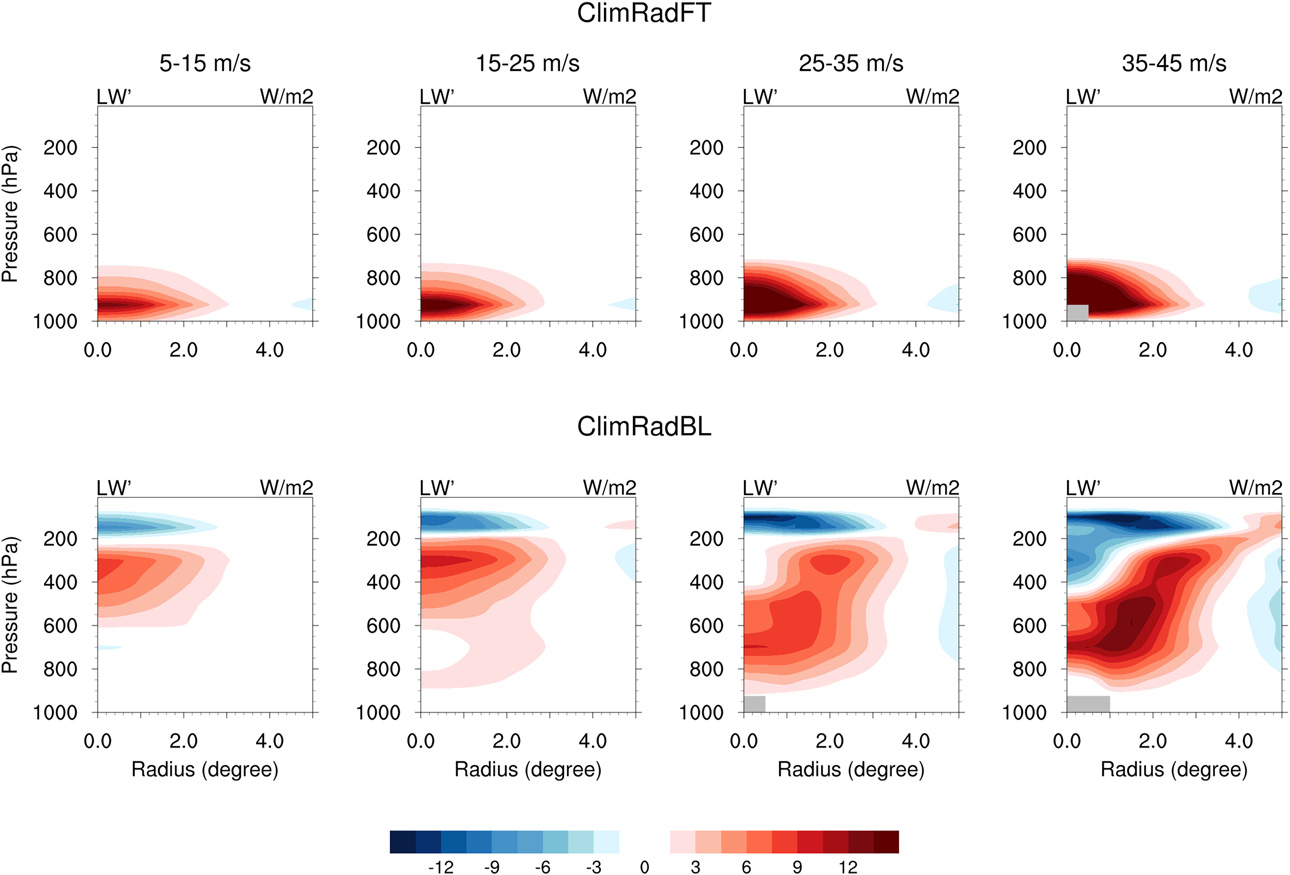
  • Method: A TC-permitting GCM with realistic boundary conditions plus mechanism-denial experiments that suppress synoptic radiative interactions in the boundary layer versus free troposphere, diagnosed with a vertically resolved MSE-variance budget.
  • Mechanism: Free-tropospheric radiative feedbacks reinforce deep-column moist-static-energy variance and convective organization, while boundary-layer effects are weaker when isolated.
  • Main Findings: Partially suppressing radiative interactions reduces global TC frequency, and free-troposphere suppression produces the larger reduction and weaker storm-supporting variance growth.

Scientific Question

How do radiative feedbacks, partitioned by altitude and process, shape moist static energy variance and energetic amplification across different tropical cyclone intensity classes?

Experimental Design

  • Vertically resolved diagnostics of LW and SW radiative feedback components.
  • Intensity-conditioned compositing over radial and pressure coordinates.
  • Budget decomposition into radiative, convergence, and advection terms for LMSE/GMSE variance.

Key Findings

  • Suppressing synoptic radiative interactions lowers global TC frequency, confirming a causal contribution from radiation-convection coupling.
  • Free-tropospheric suppression produces larger impacts than boundary-layer suppression, highlighting vertical asymmetry in feedback strength.
  • Radiative support of column MSE variance is a key pathway linking environmental thermodynamics to TC genesis likelihood.

Figures from the Study

Extracted from Zhang et al. (2023), https://doi.org/10.1175/JCLI-D-22-0199.1.