Bosong Zhang

Forcing and Feedback • Ocean Heat Uptake

Nature Climate Change (2021)

Enhanced Hydrological Cycle Increases Ocean Heat Uptake and Moderates Transient Climate Change

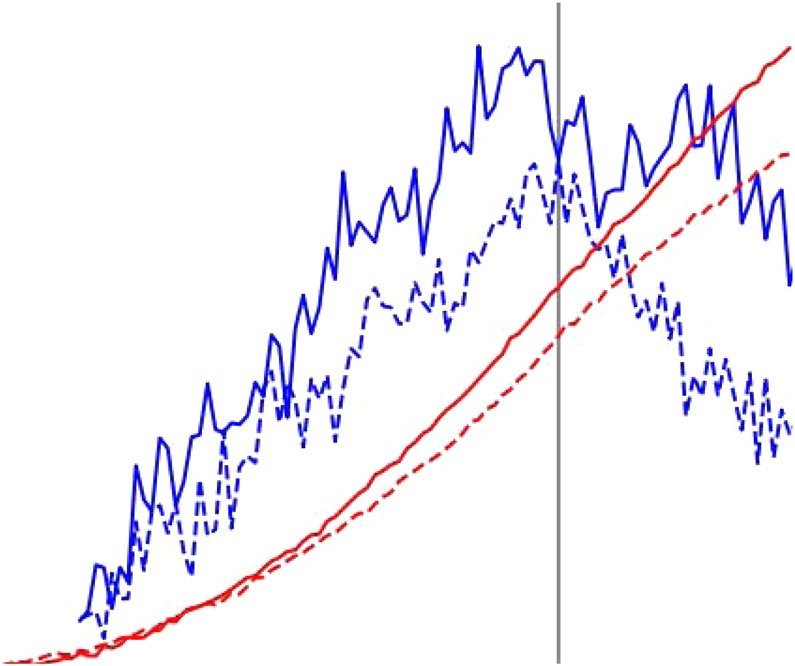
Transient CO2-doubling experiments show that subtropical surface salinification from an amplified hydrological cycle strengthens ocean heat uptake and reduces near-term surface warming.
DOI: 10.1038/s41558-021-01152-0 Transient CO2 Doubling Salinity Pattern Effect Ocean Heat Uptake
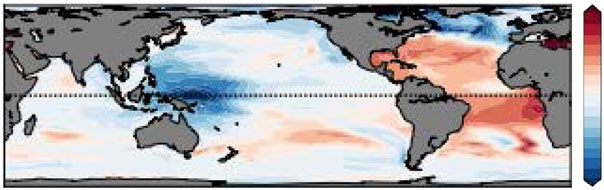
Map from Liu et al. 2021 showing ocean heat uptake response pattern
Ocean heat-uptake anomaly pattern associated with CO2-driven salinity changes.

TCR Shift: ~0.4 K

Without salinity-pattern adjustment, transient warming is substantially larger.

Subtropical Salinification

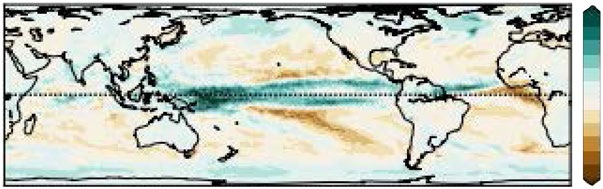
Dry-get-drier freshwater forcing increases salinity and weakens upper-ocean stratification.

Deeper Heat Sequestration

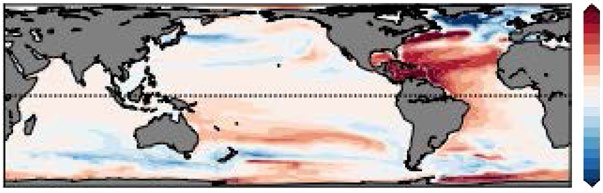
Salinity-driven buoyancy changes enhance penetration of heat into the ocean interior.

Paper Citation

Liu, M., G. Vecchi, B. Soden, W. Yang, and B. Zhang, 2021: Enhanced hydrological cycle increases ocean heat uptake and moderates transient climate change. Nature Climate Change, 11, 848-853. https://doi.org/10.1038/s41558-021-01152-0

Scientific Logic

  • Question: Does CO2-driven surface salinity change alter ocean heat uptake enough to change transient warming?
  • Method: Coupled 1% yr-1 CO2 increase experiments comparing a standard run with a fixed-SSS configuration.
  • Mechanism: Amplified P−E patterns produce subtropical salinification, reduce near-surface density stratification, and increase downward heat transport.
  • Main Findings: Salinity-pattern evolution enhances ocean heat uptake and lowers transient warming; fixing SSS raises TCR by about 0.4 K.

Scientific Objective

Quantify how hydrological-cycle amplification feeds back on ocean heat uptake and transient surface temperature response through sea-surface salinity changes.

Approach

  • Run transient CO2-doubling simulations in FLOR with and without dynamic SSS response.
  • Compare TOA imbalance, OHC tendency, and vertical heat distribution between experiments.
  • Diagnose regional salinity, freshwater flux, and overturning contributions to heat uptake changes.

Key Findings

  • Hydrological-cycle-driven salinification increases low-latitude and subtropical ocean heat uptake.
  • Additional salinity buoyancy forcing shifts warming deeper, reducing upper-ocean warming and transient surface temperature rise.
  • AMOC changes contribute secondarily; the dominant control is salinity-mediated stratification change.

Figures from the Study

From Liu et al. (2021), Nature Climate Change, https://doi.org/10.1038/s41558-021-01152-0.