Bosong Zhang

Model Development and Evaluation

Historical Precipitation Trends

Large-ensemble analyses separate forced and internal components of precipitation trends, showing that regional observations must be interpreted in a variability-aware framework.

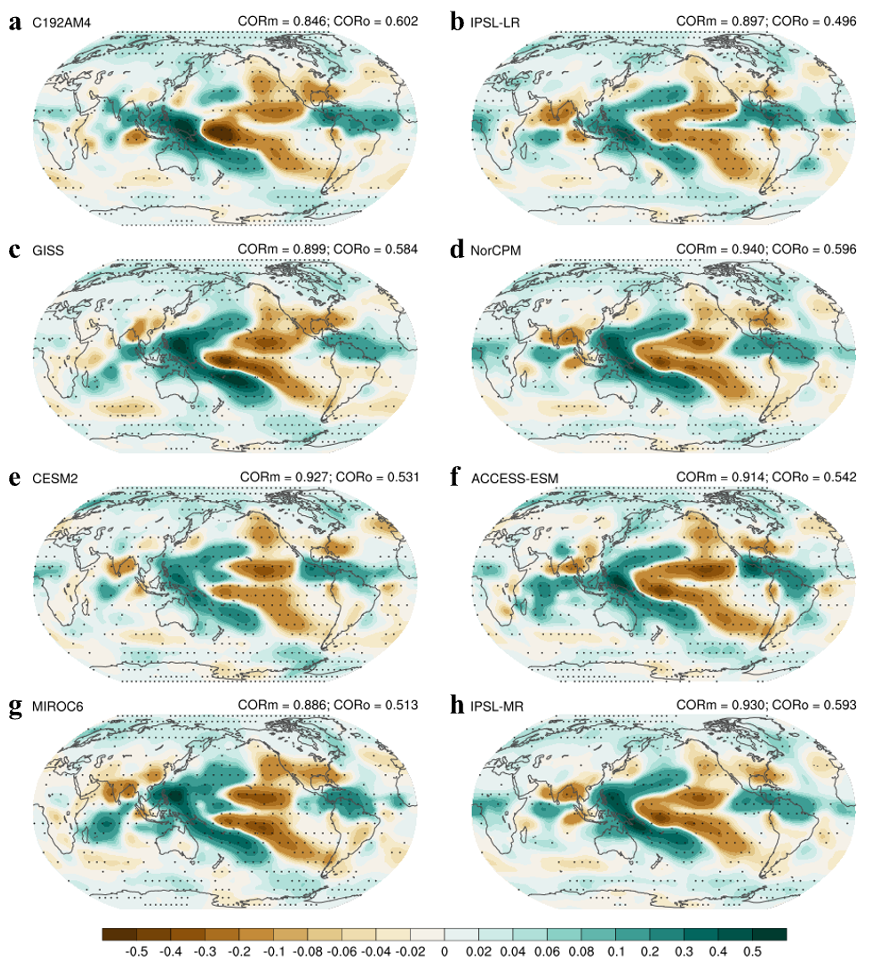
AMIP6 Ensembles Forced vs Internal Variability Observed Trend Comparison

1980-2014

Historical trend window used for model and observational comparisons

AMIP6 Multi-Model

Large ensembles isolate forced responses from internal atmospheric noise

ESSD (2025)

Confronting historical precipitation trends with observations

Related Publication

Liang, Y., et al., 2025: Confronting historical precipitation trends in models with observations: forced signal and atmospheric internal variability. Earth System Science Data.

Scientific Logic

  • Question: How much of observed regional precipitation trend is externally forced versus internal variability?
  • Method: Large-ensemble AMIP6-style analysis separating forced signal from internal atmospheric variability and comparing with observations.
  • Mechanism: Forced thermodynamic moistening interacts with circulation variability, so regional trends can deviate strongly from the ensemble-mean forced pattern.
  • Main Findings: Many observed regional trends fall within modeled variability bounds, emphasizing ensemble-context interpretation before model rejection.

Scientific Question

How much of observed regional precipitation change is externally forced versus internally generated, and how consistently do atmospheric models reproduce those signals?

Approach

  • Analyze AMIP6 model ensembles to estimate forced precipitation-trend components.
  • Compare ensemble means and spread with observational products and pattern-correlation metrics.
  • Diagnose zonal-mean and regional wetting/drying structures across hemispheres.

Key Findings

  • Internal variability can dominate regional trend realizations even under the same external forcing.
  • Observed regional trends often fall within modeled variability envelopes.
  • Model evaluation of precipitation trend skill should use ensemble context rather than single-realization comparison.

Figure