Bosong Zhang

Forcing and Feedback • Radiative Feedbacks

Journal of Climate (2024)

Nonlinear Radiative Response to Patterned Global Warming due to Convection Aggregation and Nonlinear Tropical Dynamics

Targeted SST perturbation experiments test Green’s-function additivity and show where nonlinear cloud-convection responses limit linear TOA-radiation reconstruction.
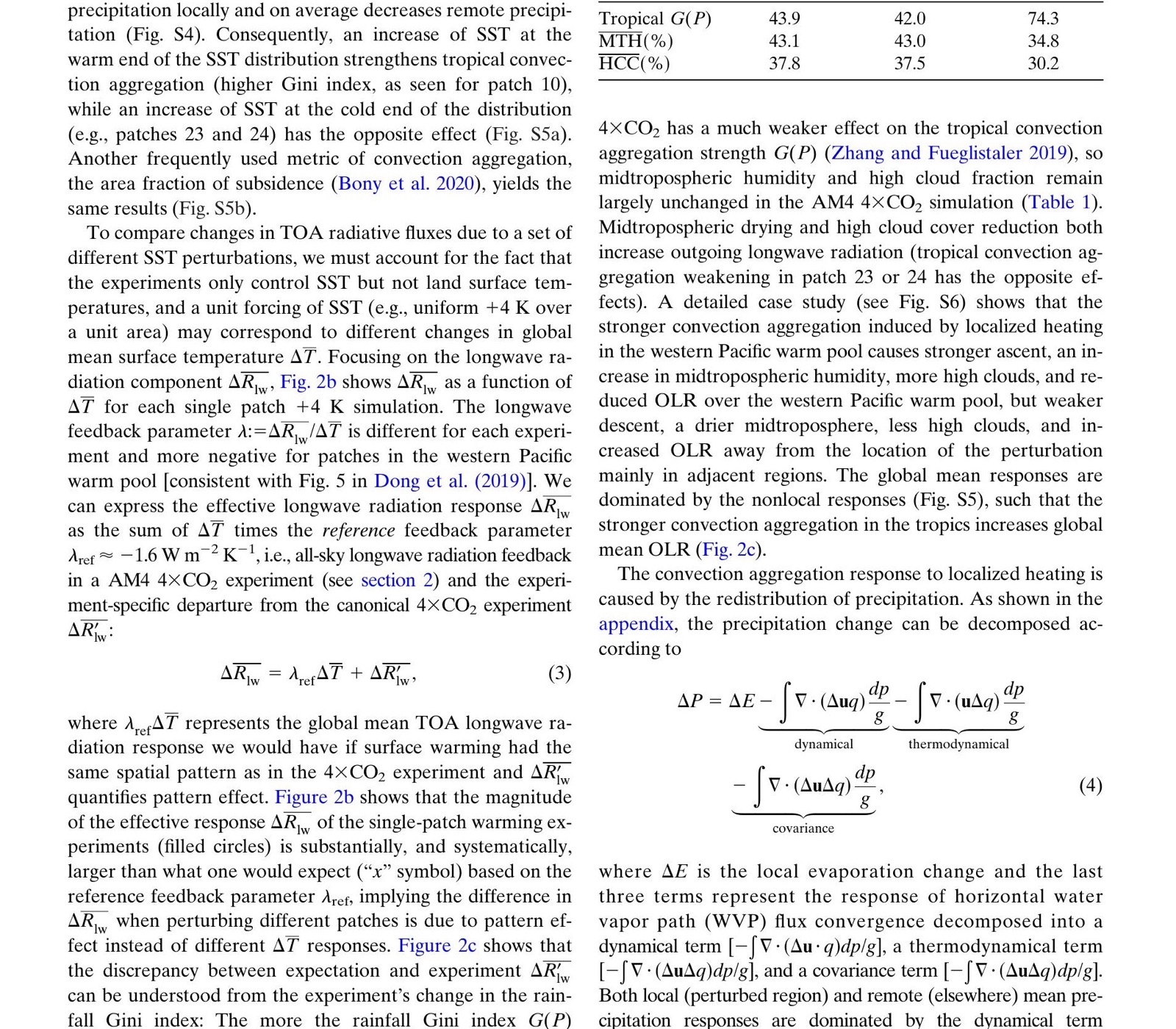
SST Additivity Test Green's Function Limits Convection Aggregation DOI: 10.1175/JCLI-D-23-0539.1
Figure from Quan et al. 2024 showing nonlinear SST additivity diagnostics
Figure from the paper highlighting nonlinear deviations from linear Green's-function superposition.

GF Overestimation

Linear superposition overestimates multipatch TOA radiative responses for large SST perturbations

Nonadditive Dynamics

Convection aggregation and circulation-induced moisture transport responses are sublinear

Sensitivity Bias Risk

Longwave cooling can be overestimated, implying underestimated effective climate sensitivity

Paper Citation

Quan, H., B. Zhang, C. Wang, and S. Fueglistaler, 2024: Nonlinear Radiative Response to Patterned Global Warming due to Convection Aggregation and Nonlinear Tropical Dynamics. Journal of Climate, 37, 5675-5693. https://doi.org/10.1175/JCLI-D-23-0539.1

Scientific Logic

  • Question: When and why does linear SST Green’s-function additivity fail in top-of-atmosphere radiation response?
  • Method: Finite-area and larger-amplitude SST perturbation experiments testing superposition skill for global and regional radiative diagnostics.
  • Mechanism: Nonlinear convection-cloud adjustments and state-dependent circulation reorganizations violate strict linear additivity, especially locally in the tropics.
  • Main Findings: Global-mean reconstruction is more robust than regional fields, but nonlinear residuals remain central for patterned-warming attribution.

Scientific Question

When does the Green's-function linear-superposition framework fail for patterned SST warming, and what physical mechanism drives the nonadditivity in TOA radiative response?

Methods

  • AM4 perturbation experiments with localized tropical Pacific SST patches (plus1 K and plus4 K).
  • Pairwise and multipatch additivity tests comparing true responses against linear superposition predictions.
  • Diagnostics linking TOA LW/SW response errors to precipitation Gini index and moisture-transport changes.

Key Findings

  • Linear superposition performs better for global-mean diagnostics than for regional tropical structure.
  • Nonlinear residuals are strongest where convective organization and cloud regimes shift.
  • Pattern-effect attribution should combine GF diagnostics with explicit nonlinearity assessment.

Figures from the Study

Rendered from Quan et al. (2024), Journal of Climate, https://doi.org/10.1175/JCLI-D-23-0539.1.

Interpretation

The study provides a mechanistic explanation for why pattern-effect reconstructions can appear accurate in weak-perturbation or historical-like regimes but break under larger future-warming perturbations: tropical aggregation and circulation responses are not linearly additive.